Community participation program—as we know it—likely to end soon
By Virginia Bruce, Chair of CPO 1, cpo1leaders@gmail.com
After a years-long decline in county support, Washington County’s once exemplary community involvement program (Community Participation Organizations—CPOs, and the Committee for Community Involvement—CCI) will end as neighbor-led organization if the Board of County Commissioners (BCC) proceeds as outlined in their December 2 work session.
The county Administrative Office delivered a presentation offering two options for the BCC to select from: “whether the Board supports retaining and modernizing the CPO framework (Option 1) or sunsetting the program and implementing a co-created district engagement model (Option 2).”
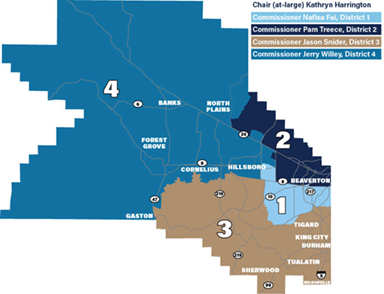
Most of the commissioners favored Option 1 which seems to effectively eliminate community-elected leaders. The degree of community input, how it will be gathered, and from whom, is unknown at this time. “…the County would…restructure it into a clearer, more efficient model centered around commissioner districts. Rather than operating 14–17 separate CPO groups, each district would host one consolidated CPO that meets every other month.” We are in District 2.
Option 1 also proposes “more relevant meetings that address a broad range of County services rather than being constrained by historical land-use expectations.” The functions of CCI, which has been a leadership group for the CPOs and advisers to the BCC on land use issues, would be transitioned to the Planning Commission, whose members are appointed by commissioners. The Planning Commission presently only deals with long-range planning issues, not the current planning of developments in neighborhoods. Given the state and county emphasis on “streamlined” development approval to increase housing, removing the pesky interference from the community may be part of the plan.
We expect that the revised Resolution & Order (R&O) that will outline the new system will be presented to the BCC at their January 6 meeting, giving the community little time to respond. The documents won’t be available until December 31. CPO meetings are slated to continue through March, and then the outlines of the new program will emerge.

County leaders base some of their decision to change the program on dwindling attendance and engagement. However, we had around 80 people attending our CPO 1 October meeting centered on the Transitional Housing facility. This has been typical over the years: attendance and interest surges when there’s a controversial issue on the agenda. Will the county-led organization respond to neighbors’ concerns as we have done in the past?
In addition, when the program first transitioned to county management in 1986, there were 3-4 full time dedicated support people for the 14 active Community Participation Organizations (CPOs) and the Committee for Community Involvement (CCI). Now we have less than one employee’s time to support our programs. Because of the added burden on volunteers, leadership has dwindled and aged—it’s usually only retired people who have the time to create and lead programs and respond to neighbors’ questions about how to interact with county agencies. We have also lost our ability to connect with our members because staff has control of the extensive email lists that connect neighbors to the program, and they often heavily edit or refuse our requests to share important information in a timely manner.
For many years, the $350,000 of Video Lottery funds allocated to Community Engagement was used entirely to support the CPOs and the CCI. In recent years, in an effort to support inclusion of historically overlooked area residents in county decisions, the Office of Inclusion, Equity, and Community Engagement, now the Office of Access and Opportunity (OAO) was created to manage all Community Engagement Activities including the CPO and CCI programs.
With the new focus, the same $350,000 yearly budget is now being used to fund not just the CPO and CCI programs, but also the Civic Leaders Training (estimated cost at over $90,000), serving only about a dozen participants per year and generally available only to people of color or those with a disability; staffing for administration of the county’s many Boards and Commissions; and primary support of the Advisory Council on Racial Equity (ACRE) (estimated cost at over $28,000).
As more OAO staff attention is directed to serving the under-represented groups, less staff time is available to support volunteers in the CPO/CCI program. Unfortunately, the budget category for Community Engagement is still titled “Community Participation Organization” making it appear to our County Commissioners that all of the $350,000 in Lottery funds is still being spent on the CPO/CCI program. Furthermore, lack of detailed reporting by OAO makes it difficult to determine exactly how much staff time is allocated to the CPO/CCI program and what the actual costs are to run the program. Budget concerns were mentioned as part of the rationale to eliminate CPO/CCI but it’s unclear how much will be saved.
These opinions are my own, based on my participation in the CPO and CCI program since 2004. They don’t necessarily represent the views of members of CPO 1 or the CCI. I’m personally saddened by this development, and also the anticipated end of the Washington County History Museum as we have known it. It doesn’t feel like community members have much of a say in Washington County these days.
While community input is unlikely to make any difference at this point, the January 6 Board Meeting will be open to the public and comments will be heard (This link goes to the page for the December 2 Work Session, but the agenda and materials for the January 6 meeting (at 10 am) should appear in the sidebar by December 31.) Sign up here to make a live comment either in person or over zoom. If you have ever valued your CPO, whether on a land use issue in your neighborhood or from learning about county issues and services, please try to attend the meeting in person or on Zoom, and email a comment to our Commissioner Pam Treece (who is currently campaigning to become Board Chair) or use the constituent comment form.