Eagle Scout Leads Habitat Restoration Effort at Jordan Woods Natural Area
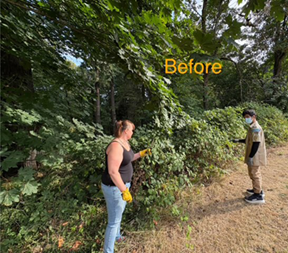
This year, Cedar Mill’s Jordan Woods Natural Area received a meaningful ecological boost thanks to the leadership and dedication of local Scout Rishan Chakraborty of Scout Troop 339, who completed his Eagle Scout service project with a large-scale Habitat Restoration Project for Jordan Woods.
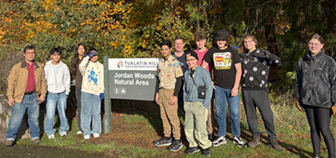
Jordan Woods Natural Area, an 18-acre site located in the Cedar Mill area adjacent to Jackie Husen Park on NW Reeves, is a treasured green space overlooking Cedar Mill Creek. While the site provides important recreational and environmental value to the community, portions of the area have been increasingly impacted by invasive plant species. Rishan’s Eagle project focused on restoring 2.5 acres of this natural area, managed by the Tualatin Hills Park & Recreation District (THPRD), the project’s beneficiary.
Rishan began his Scouting journey in 2018 as a Cub Scout with Pack 718 while in third grade and transitioned to Scouting America (formerly Boy Scouts of America) in 2021. As he progressed through the program, he became particularly drawn to conservation-based service. In 2023, Rishan participated in a conservation project organized by another Scout for THPRD, an experience that inspired him to pursue a similar path for his own Eagle Scout project.
“In recent times, natural ecosystems around the world have faced unprecedented challenges,” Rishan noted. “Invasive species are one of the biggest threats to biodiversity and ecological balance, and I wanted my project to address that issue.”
With guidance and support from Melissa Marcum, THPRD’s Volunteer Services Specialist and project supervisor, Rishan planned and organized a comprehensive effort to remove invasive species from Jordan Woods. Over a weekend in August, approximately 15 volunteers worked together to remove Himalayan blackberry, English ivy, chocolate vine, bamboo, lemon balm, and Italian arum. Following THPRD-approved methods, volunteers hand-pulled and cut vegetation and dug out roots using tools such as mattocks and shovels to prevent regrowth.

Himalayan blackberry, one of the most notorious invasive species in Western Oregon, forms dense, thorny thickets that crowd out native plants, increase erosion, and degrade wildlife habitat. Chocolate vine poses a similar threat, aggressively climbing trees and suppressing native vegetation. Removing these species was a crucial first step toward restoring the ecological health of the area.
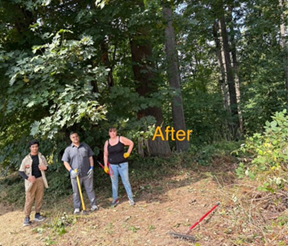
Restoration continued into the fall planting season. In November, another group of roughly 15 volunteers returned to plant 178 native plants, reintroducing species essential to long-term habitat recovery. The planting included 11 native species: white oak, big leaf maple, Oregon grape, Indian plum, mock orange, twinberry, spirea, sedge, wild rose, ocean spray, and Pacific ninebark. All plants were generously donated by Clean Water Services. Reestablishing native vegetation will support biodiversity, stabilize soil, and provide food and shelter for local wildlife.
One of the most rewarding aspects of the project was the broad community involvement it inspired. Volunteers came from Scout Troops 339 and 618, Portland Community College, Century High School, Jesuit High School, and the surrounding Cedar Mill neighborhood. “Bringing together people from so many different groups was the best part of the project,” Rishan shared.
From his initial outreach to THPRD in March through project completion in December, Rishan dedicated approximately 65 hours to planning, coordination, and hands-on work. He acknowledged that recruiting volunteers was the most challenging part of the process, but he was grateful for the enthusiasm and commitment of those who participated. “I’m very grateful to everyone’s dedicated effort towards this project,” he said.
Rishan hopes his project will inspire younger Scouts and Cedar Mill community members to get involved in conservation efforts. He encourages those interested in habitat restoration or volunteering to contact THPRD, whose staff he described as “extremely helpful and supportive throughout the entire process.”
Through leadership, collaboration, and a deep commitment to environmental stewardship, Rishan Chakraborty’s Eagle Scout project has left a lasting positive impact on Jordan Woods and on the Cedar Mill community as a whole.