Japanese beetle eradication program ends as state funding fails
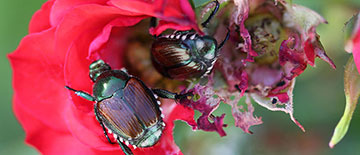
The Oregon Department of Agriculture (ODA) has been conducting an effort to prevent the spread of the destructive pest that invaded Cedar Mill in 2016. The 2025 Oregon Legislature failed to pass a bill (SB 576) that would have continued funding for the effort, leaving farmers, nursery owners, and gardeners to deal with the problem alone.
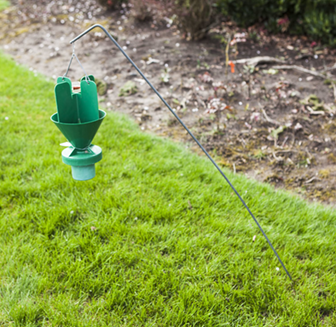
We spoke with Cody Holthouse, Insect Pest Prevention & Management Program Manager for ODA. The staff is disappointed to learn that the program, which has been very successful in limiting and eradicating Japanese beetles (JB) from the area, will have to close. “We have no plans to continue since there will be no way to carry on the program without the funding,” he said. “There’s a small emergency fund from the Oregon Invasive Species Council and the Oregon Association of Nurseries that will let us finish collecting from our traps through September, but after that we are done.”
Oregon has been part of a multi-state effort to suppress the JB. “The other states are either beetle-free or are actively conducting treatment. Oregon will lose that status.” That will mean Oregon nurseries will be limited in exporting some agricultural products to other states.
The treatment program consisted of application of a granular larvicide each spring, timed to reach the grubs that develop underground and emerge in the summer and fall. The larvicide, Acelepryn G, is fairly specific to the beetles and a few other non-pollinator species and is safe for use on agricultural products. The labor-intensive treatment, applied primarily to lawns around our area, was carried out by workers contracted by ODA, which was a large part of the budget.
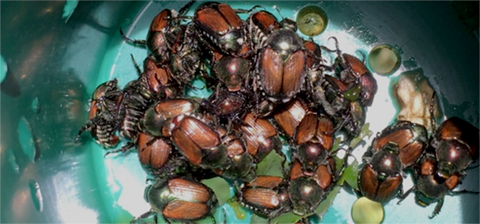
In 2017, when traps were first deployed widely, ODA collected nearly 24,000 beetles. By 2024, the number was down to a little more than 1000 outside of a farm that had been resisting treatment until recently. That represents a huge success, so it’s very discouraging that the program has to stop so close to the finish line. “Even if the legislature restored funding during the 2026 short session, we’d not be able to gear up to continue right away,” Holthouse said.

In addition to attacking roses (the traps are baited with a rose scent) Japanese beetles devastate garden ornamentals and agricultural crops, such as hops, nursery plants, cannabis, and wine grapes. Homeowners who have still been experiencing beetle damage can purchase Acelepryn G online and at some home and garden stores. The ODA hopes that the end of the program won’t result in the use of broader-spectrum insecticides because they also kill highly desirable pollinator species.
We can help prevent the spread of the beetle by not moving plants and their soil outside of the affected area. You don’t want to share beetle larvae with your gardening friends!
The ODA JB website has information about the beetle and the program, and resources for learning more. The ODA email address for the beetle project, Japanese.beetle@oda.oregon.gov, will remain active if you have questions.