County museum and collections future still uncertain
By Virginia Bruce
The items and documents that tell the story of Washington County have been collected over the years and, since 1982, were kept at a building on the campus of Portland Community College, Rock Creek Campus (PCC). In January we learned that the latest group to manage this heritage had failed to obtain the funding necessary to keep it open.
PCC owns the land and has leased it to the museum for $1 per year as long as it operates as a museum. The building had been owned by the non-profit Washington County Museum dba Five Oaks, but the county terminated the 1987 agreement and took over the building in April. The county owns the collection and has provided partial funding for museum operation. Without the private foundation support that had been dwindling for several years, the Five Oaks board pulled the plug.
Maintaining historical artifacts and documents requires climate control and safety. Since January the county has been funding building operations and has hired a part-time employee to oversee these efforts and help county administrators understand the extent of the collection. A full inventory of the collection doesn’t exist, and the previous managers weren’t using updated collections software.
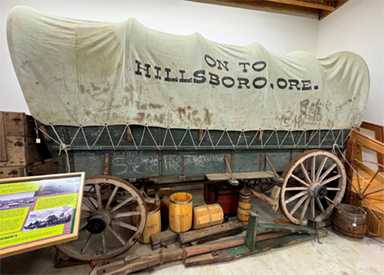
items at risk from the county collection
In late August, the County Board of Commissioners (BCC) met with county staff to hear options and provide further direction to the team working on the issues around the museum and the collections.
Staff explained that some of the documents and records stored at the museum were county administrative records that the county was legally bound to keep. Others were historically significant. Some of the artifacts were priceless, while some were duplicates or not so historically significant.

Four options were outlined. The first would follow museum standards to deaccession (get rid of) all physical assets except the county administrative documents and would require a five-person team for five years. The second option would simply get rid of the non-governmental assets as surplus property, requiring a three-person staff for three years.
Both of those options would result in the entire collection being scattered or discarded and likely unavailable to history researchers and the public.
Option 3 would establish an imaging and resource center in the building. The county’s imaging facility would be relocated and would be able to digitize some of the records in addition to performing regular work. Artifacts would be culled to only retain items with historical significance, and the collections could be available to the public for research by appointment or during limited hours.
Option 4 would transfer the artifacts, and presumably the building, to private or community ownership. This would require a group to form and obtain pledges of ongoing support. The county would issue a Request for Proposals.
While BCC Chair Harrington saw the collections as a liability and favored either option 1 or 2, the other four board members recognized the cultural significance of the heritage embodied in the collection and voted to ask staff for more information on options 3 and 4.
Members of local history groups have been meeting for many years as the Washington County History Roundtable. Following the BCC Work Session in late August, the group met again. They questioned the cost estimates provided by county staff and agreed to continue work to investigate the feasibility of forming a group to take over the museum. If any readers have ideas or an interest in being involved, please let me know and I’ll forward it to the Roundtable leaders.